
· Nora Whitfield
How to put a harness on a dog
Most harnesses are put on wrong in the same way, and it produces the same three complaints: the dog trips over the leash, the harness rides up on the throat, and the dog backs out of it. All three come from the chest panel sitting too high.
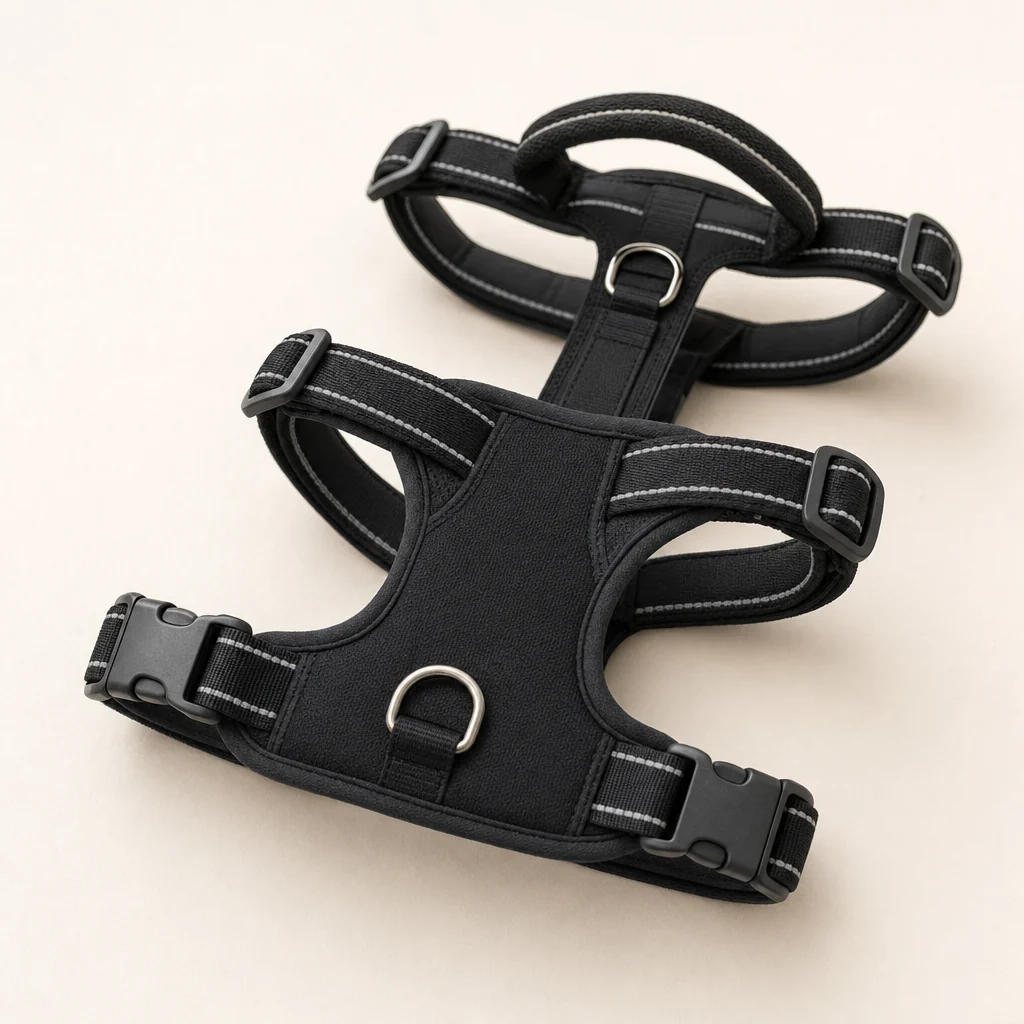
First, work out which type you have
Almost every harness sold falls into one of two patterns, and they go on differently. Getting this wrong is why some dogs fight the process.
| Type | How you recognise it | How it goes on |
|---|---|---|
| Over-the-head | A closed padded neck opening, one or two buckles on the girth strap | Head through the opening first, then buckle underneath |
| Step-in | Two loops that lie flat on the floor, buckle on the back | Front feet into the loops, then lift and clip on the spine |
The harnesses we sell are the over-the-head type: a padded neck opening with side-release buckles on the girth. If yours clips on the back and has two floor loops, follow the step-in instructions further down.
Over-the-head harnesses, step by step
1. Unclip the girth buckles and lay it out. Hold it up and find the neck opening — the smaller, padded loop. The wide panel that hangs below it is the chest panel, and on a no-pull harness it carries the front D-ring.
2. Orient it before it touches the dog. The handle and back ring go on top, along the spine. The chest panel goes down the front of the dog. Half the struggle people have is putting a harness on upside down and then fighting the geometry.
3. Head through the neck opening. Hold the opening wide with both hands and bring it over the nose and ears in one smooth movement. If your dog dislikes things over its head, hold a treat through the opening so it puts its own head through to reach it. That single change turns a wrestling match into a trick the dog volunteers for.
4. Drop the chest panel onto the breastbone. This is the step everyone skips. The panel should sit low, on the sternum, in front of the shoulder joint — not up against the throat. Push it down with your hand and hold it there while you do the next step.
5. Buckle the girth strap behind the front legs. It passes under the chest and clips on the side. Leave roughly two fingers of space behind the elbow so it does not chafe.
6. Adjust in this order: girth first, then neck. Snug the girth to the two-finger test. Then lengthen the neck straps until the chest panel settles down onto the breastbone. Doing it the other way round is what leaves the panel sitting high.
The two-finger test, done properly
Slide two flat fingers — flat, not stacked — under each strap in turn. They should pass with mild resistance. If they slide freely, it is loose. If you cannot get them under, it is tight.
Check every strap, not one. The single most common fitting fault is a girth strap set correctly and neck straps left at the factory setting, which holds the chest panel up on the throat and leaves the harness looking fitted while behaving loose.
Why this matters more than it sounds
Three complaints about no-pull harnesses trace back almost entirely to a chest panel sitting too high.
“The leash catches his front legs.” With the panel high, the D-ring ends up under the chin and the line drops across the forelegs on every stride. Set on the breastbone, the ring sits ahead of the legs and the line stays clear.
“It rides up and chokes him.” A high panel has nowhere to go but the throat once the dog leans forward. That defeats the entire reason for choosing a harness over a collar.
Significant rise in intraocular pressure — when leash force went through a collar, across 51 eyes of 26 dogs; no rise through a harness. (Pauli et al., JAAHA 42(3):207–211, 2006)
“He backs straight out of it.” The neck is the narrowest part of a dog's front end. A panel riding up sits exactly at that diameter, which is the diameter a dog needs to reverse through. Drop the panel and the escape route closes. More on that on the escape-proof harness page.
Step-in harnesses
Lay it flat on the floor with the two triangular openings facing up and the buckle at the top. Stand your dog over it, lift one front foot into the first opening and the other into the second, then bring both sides up along the ribs and clip on the back. Adjust the same way: girth first, then the rest.
Step-ins almost always attach on the back only, which makes them a poor choice for a dog that pulls:
16.87 N vs 6.97 N — peak leash tension on a back-attachment harness versus a plain collar, across 52 dogs; the dogs also spent about twice as much of the walk pulling (p = 0.031). (Shih et al., Frontiers in Veterinary Science 8:735680, 2021)
They are a reasonable choice for a small dog that walks well and objects to things going over its head.
Dogs that hate being harnessed
Nearly always a handling problem rather than a harness problem. Three things fix most cases.
Take the pressure off. Put the harness on the floor and feed the dog next to it for a few days. Then hold it up and feed. Then feed through the neck opening. You are teaching “harness predicts food” before it ever means “harness predicts restraint”.
Stop reaching over the head. Approach from the side, at chest height. A hand coming down over a dog's skull is threatening to most dogs and merely tolerated by the rest.
Do it when nothing else is happening. If the harness only ever appears thirty seconds before a walk, the dog is at its most excited exactly when you need it still. Put it on at random times and take it off again.
No measurable stress difference — in behaviour between collar-walked and harness-walked dogs, across 30 pet dogs. (Grainger, Wills & Montrose, J. Vet. Behavior 11:60–64, 2016)
Worth knowing if you feel guilty about the whole business: across 30 dogs, walking on a harness produced no more stress behaviour than walking on a collar. The equipment is not what your dog is reacting to — the handling around it is.
After the first week
Webbing settles and buckles creep. Re-run the two-finger test after about a week, and again after a wash. A harness that was correct on day one is commonly a finger looser by day seven, and that is enough to change how it behaves under a hard pull.
Next: how to measure a dog for a harness if you are not sure of the size, front clip versus back clip for the attachment question, and the front-clip harness itself. Sizing help is on the small dog and big dog pages.

Nora Whitfield · Leash-training specialist, Heelbrook
Nora has spent twelve years walking dogs that pull — first as a shelter volunteer, now fitting harnesses full time. She has fitted and stress-tested more than 400 harnesses across every body shape, and she still walks two ex-shelter pullers of her own.